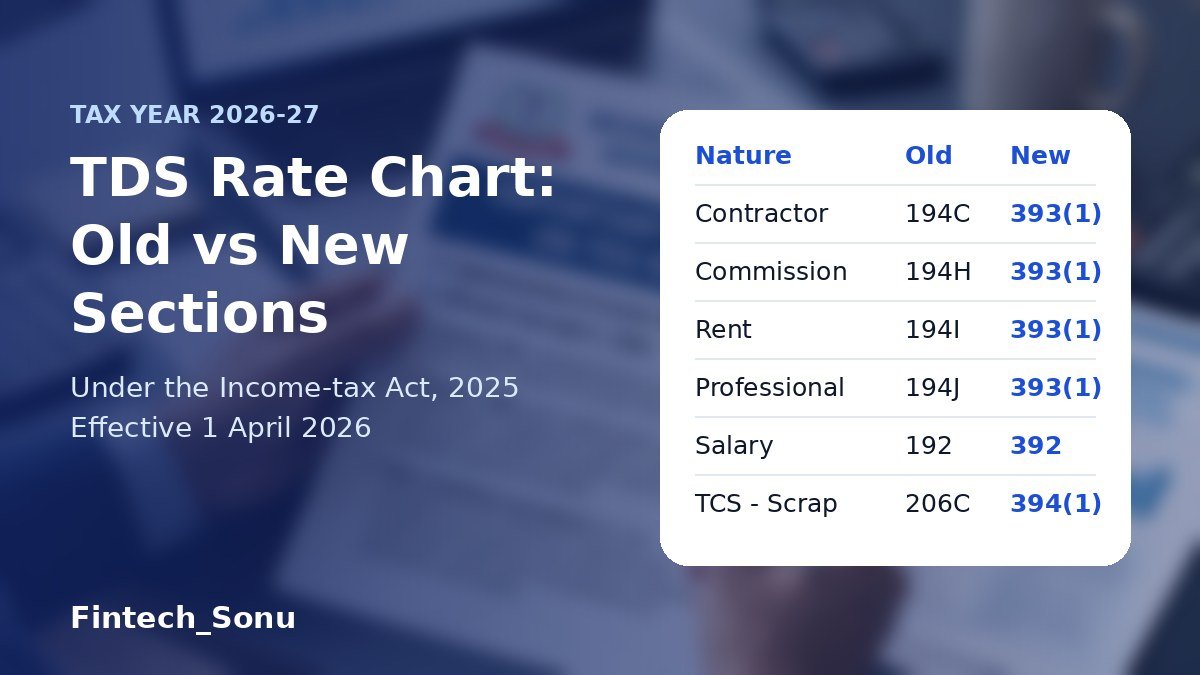
From 1 April 2026, TDS in India runs under the Income-tax Act, 2025. The familiar section numbers that every accountant knows by heart — 194C, 194J, 194H and the rest — have been folded into a handful of new sections. The good news: for most payments, the rates and thresholds have not changed. What has changed is how you label, deduct and report them.
This guide gives you a side-by-side chart of old and new sections for Tax Year 2026-27, plus the points that most often trip up businesses during the switch.
What changed in the new Act
- Section 392 now covers TDS on salary (old Section 192) and taxable EPF withdrawals (old 192A).
- Section 393 brings almost every other TDS provision — interest, dividend, contractors, commission, rent, professional fees, purchase of goods and more — into one section with a table. Each payment type is identified by its serial number in that table.
- Section 394 covers TCS (old Section 206C).
- “Previous year” and “assessment year” are replaced by a single “tax year”. FY 2026-27 is Tax Year 2026-27.
- Each type of payment now has a payment code that is used in TDS returns and challans.
TDS rate chart – Tax Year 2026-27
| Nature of payment | Old section | New section | Payment code | Threshold | Rate |
|---|---|---|---|---|---|
| Salary | 192 | 392 | 1001 / 1002 | Basic exemption limit | Slab rates |
| Taxable EPF withdrawal | 192A | 392(7) | 1004 | ₹50,000 | 10% |
| Interest on securities | 193 | 393(1) [Sl. 5(i)] | 1019 | ₹10,000 | 10% |
| Dividend | 194 | 393(1) [Sl. 7] | 1029 | ₹10,000 (resident individual, non-cash) | 10% |
| Bank / post office interest – senior citizens | 194A | 393(1) [Sl. 5(ii).D(a)] | 1020 | ₹1,00,000 | 10% |
| Bank / post office interest – others | 194A | 393(1) [Sl. 5(ii).D(b)] | 1021 | ₹50,000 | 10% |
| Interest – other cases | 194A | 393(1) [Sl. 5(iii)] | 1022 | ₹10,000 | 10% |
| Contractor – Individual / HUF | 194C | 393(1) [Sl. 6(i).D(a)] | 1023 | ₹30,000 single / ₹1,00,000 in the year | 1% |
| Contractor – Others | 194C | 393(1) [Sl. 6(i).D(b)] | 1024 | ₹30,000 single / ₹1,00,000 in the year | 2% |
| Commission / brokerage | 194H | 393(1) [Sl. 1] | 1006 | ₹20,000 | 2% |
| Rent – plant & machinery | 194-I(a) | 393(1) [Sl. 2(ii).D(a)] | 1008 | ₹50,000 per month | 2% |
| Rent – land, building, furniture | 194-I(b) | 393(1) [Sl. 2(ii).D(b)] | 1009 | ₹50,000 per month | 10% |
| Fees for technical services | 194J | 393(1) [Sl. 6(iii).D(a)] | 1026 | ₹50,000 | 2% |
| Fees for professional services | 194J | 393(1) [Sl. 6(iii).D(b)] | 1027 | ₹50,000 | 10% |
| Director’s fees | 194J | 393(1) [Sl. 6(iii).D(b)] | 1028 | Nil | 10% |
| Business perquisite / benefit | 194R | 393(1) [Sl. 8(iv)] | — | ₹20,000 | 10% |
| Payment to partners by a firm | 194T | 393(3) [Sl. 7] | 1067 | ₹20,000 | 10% |
| Purchase of goods | 194Q | 393(1) [Sl. 8(ii)] | 1031 | Above ₹50 lakh in the year | 0.1% |
| TCS on sale of scrap | 206C(1) | 394(1) [Sl. 4] | 1073 | Nil | 2% |
Points to watch
- Rates mostly unchanged. For most payments, only the section number changes. Your deduction percentages stay the same.
- TCS on scrap is now 2%, up from 1%, with no threshold. Update your sales invoicing if you sell scrap.
- Director’s fees have no threshold. The ₹50,000 limit for professional fees does not apply, so deduct 10% from the first rupee.
- Contractor threshold has two tests. Deduct when a single payment crosses ₹30,000 or total payments in the year cross ₹1,00,000.
- Purchase of goods (old 194Q) applies only if the buyer’s turnover exceeded ₹10 crore in the previous year, and only on the amount above ₹50 lakh.
- No PAN, higher rate. If the payee does not give a valid PAN, a higher TDS rate applies.
What your business should do now
- Update your accounting software. In Tally or your ERP, map every TDS nature of payment to its new section and payment code.
- Review vendor masters. Check that each vendor is tagged with the right payment type — contractor, professional, technical, rent — because the codes differ.
- Brief your team. Anyone who books bills or makes payments should know the new section references.
- Check the first returns carefully. The first quarter’s TDS returns under the new codes are where mistakes are most likely.
Note: Payment codes are taken from the new TDS return formats. Always confirm them against the latest CBDT notifications before filing. This article is for general information and is not tax advice for your specific situation.
Need help moving your TDS to the new Act? We set up section mapping in Tally, review vendor masters and file TDS returns for growing businesses. Talk to us on WhatsApp.