A D2C brand moves fast: daily orders across your website and marketplaces, returns, ads, inventory, and payments landing from five different places. Without a fixed month-end routine, small errors pile up until year end — when they’re hardest to fix.
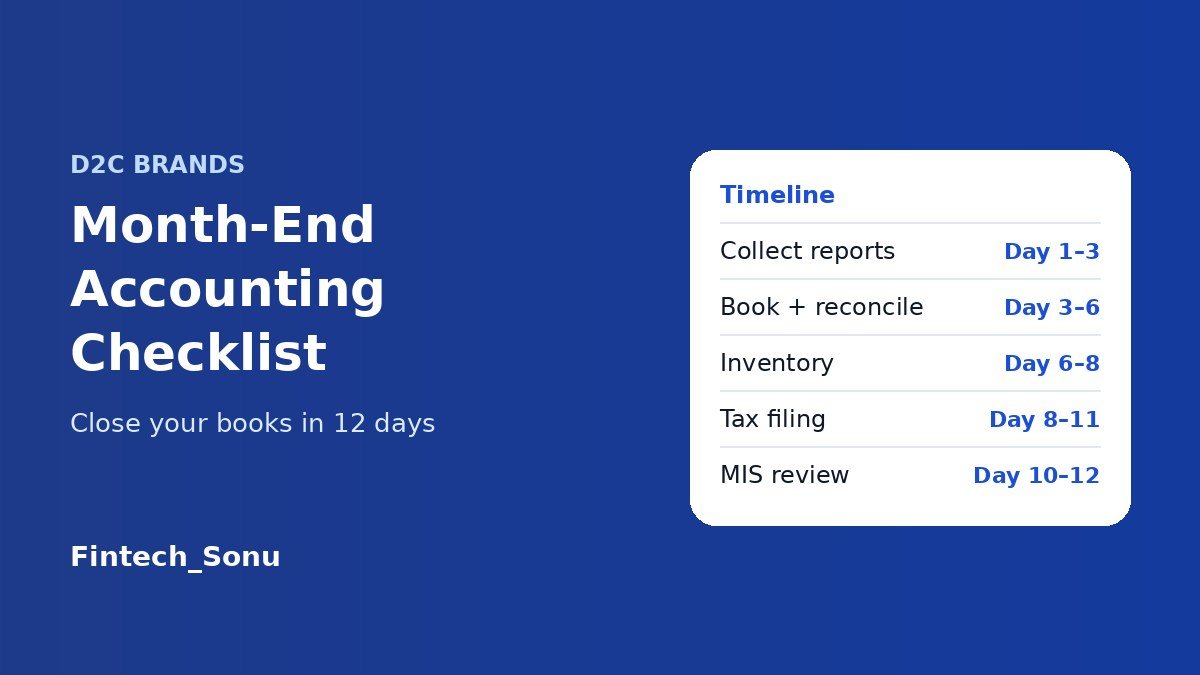
Here’s a practical month-end close checklist you can follow every month. Most of it can be done in the first 10 days of the next month.
Days 1–3: Collect everything
- ☐ Download sales and settlement reports from every marketplace — Amazon, Flipkart, Meesho, Myntra, Nykaa, and others.
- ☐ Export your Shopify (or website) orders, refunds and payouts.
- ☐ Download payment gateway settlement reports (Razorpay, Cashfree, PayU, etc.).
- ☐ Get COD remittance reports from your logistics partners.
- ☐ Collect all purchase bills, marketplace fee invoices and expense bills.
- ☐ Download bank statements for all accounts.
Days 3–6: Book and reconcile
- ☐ Book sales from each channel at full value, with GST.
- ☐ Book marketplace fees, gateway charges and shipping as expenses, with input GST.
- ☐ Book returns, RTO and refunds as credit notes.
- ☐ Book TCS and TDS deducted by marketplaces as receivables.
- ☐ Bank reconciliation: match every credit and debit with your books.
- ☐ Channel reconciliation: check that each marketplace and gateway ledger matches what’s still due to you.
Days 6–8: Inventory and costs
- ☐ Update stock — in your warehouse, at marketplace fulfilment centres, and in transit.
- ☐ Check returned stock: back in sellable condition, damaged or missing?
- ☐ Calculate cost of goods sold for the month.
- ☐ Book ad spend from Meta, Google and marketplace ads.
- ☐ Book salaries, rent, software and other fixed costs, including accruals for bills not yet received.
Days 8–11: Tax and compliance
- ☐ Deduct and deposit TDS on payments like rent, contractors and professional fees (due by the 7th).
- ☐ Accept marketplace TCS on the GST portal.
- ☐ Match input tax credit with GSTR-2B.
- ☐ File GSTR-1 (by the 11th for monthly filers), including Table 14 for marketplace sales.
- ☐ File GSTR-3B and pay GST (by the 20th for monthly filers).
Due dates differ for quarterly filers and can be extended, so check the GST and income-tax portals each month.
Days 10–12: Review your numbers (MIS)
- ☐ Sales by channel — which marketplace or website grew or dropped?
- ☐ Gross margin by channel and by top products.
- ☐ Marketing cost as a share of sales.
- ☐ Return and RTO rate by channel.
- ☐ Net profit and cash in the bank.
- ☐ Cash forecast for the next 4–8 weeks: stock purchases, ads, salaries, taxes.
Why it’s worth the effort
A monthly close catches fee errors and missing payouts while you can still claim them, keeps GST notices away, and gives you numbers you can trust when deciding where to spend on ads or stock. It also makes year-end audits, ITR filing and fundraising much faster.
Related reading: 7 steps to take control of your business money and how to read a Flipkart settlement report.
This checklist is general guidance. Adjust it to your channels, filing frequency and business size.
Want this done for you every month? We run the full month-end close for D2C brands and send you a clear MIS report. Talk to us on WhatsApp.